

Interpretation of the Revised Cybersecurity Law of the People's Republic of China: Focusing on Strategic Trends, AI Governance, and Risk Compliance
01. Executive Summary and Strategic Overview
1. The historical background and core legislative intent of the revision
The revision of the Cybersecurity Law was carried out after the successive implementation of the Data Security Law (DSL) and the Personal Information Protection Law (PIPL). Its core purpose is to address issues such as insufficient deterrent power of punishment, lack of higher-level legal basis for regulating emerging technologies (such as artificial intelligence), and poor internal connection within the legal system that have been exposed in legal practice. The revision work reflects the strategic intention of the country to promote network security governance from basic framework construction to strict implementation and system integration.
The core strategic focus of this revision includes three aspects: firstly, strengthening the political and security orientation, clarifying the highest guiding principles through new provisions, elevating cybersecurity work to the core position of overall national security, and requiring coordinated development and security. Secondly, the inclusion of new risks in regulation, the establishment of specialized provisions for artificial intelligence (AI) for the first time, and forward-looking governance of algorithms, computing power, and ethics. Finally, the exponential increase in legal liability has significantly raised the upper limit of administrative fines for both units and individuals (up to RMB 10 million), and expanded the scope of individual accountability, forming a strong compliance deterrent.
2. Overview of Core Revision Points
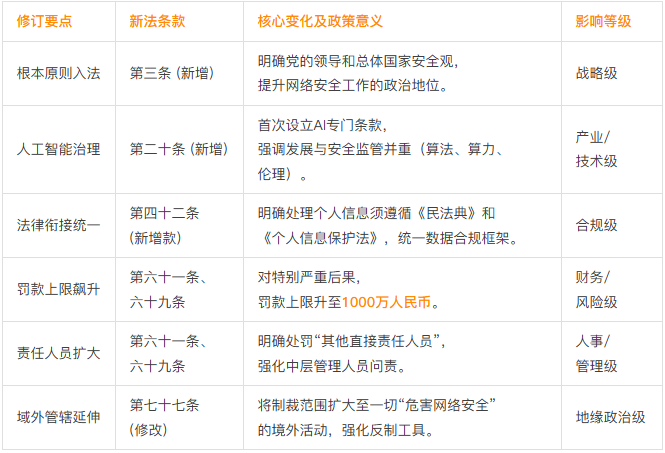
The following table summarizes the core changes and policy implications related to legal principles, technical regulation, legal liability, and extraterritorial jurisdiction in this revision.
Table 1: Overview of the Core Revision Points of the Cybersecurity Law (to be implemented from January 1, 2026)
02. Strengthening Legal Basis and Guiding Ideology: Integration of National Strategy
1. Legalization of Fundamental Principles: Strategic Significance of the New Third Article
One of the most important structural changes in this revision is the addition of a third article in the General Provisions section, which clarifies the fundamental principles of network security work.
The new Article 3 stipulates that "the network security work shall adhere to the leadership of the CPC, implement the overall national security concept, coordinate development and security, and promote the construction of a network power.". This new provision directly incorporates the political nature of cybersecurity work and the national security bottom line into the beginning of the law, making it the highest principle guiding the interpretation and regulatory enforcement of all subsequent provisions. In practice, this principle requires that cybersecurity is no longer seen solely as a technical or operational issue, but as a political task to maintain national power, economic stability, and social public interests. The punishment judgment of regulatory authorities for violations will extend from simply evaluating the severity of technical consequences to assessing their potential risks to national security and political stability.
The original Article 3 of the Cybersecurity Law (which emphasizes the equal importance of network security and information technology development, and follows the principles of active utilization and scientific development) has been retained and moved to the new Article 4. This reservation of the principle of technological development, closely following political principles, reflects the strategic layout that "development" must obey "security" and "overall national security concept". At the same time, the principle of "promoting the construction of a strong cyber nation" requires the country to encourage innovation and application of network technology while ensuring security. This, together with the newly added AI clause (new Article 20), constitutes a dual policy goal of achieving independent controllability in key technologies while strengthening supervision.
2. Adjustment of legislative structure and displacement of articles
In order to accommodate the addition of the third and twentieth articles, although the majority of the original provisions remain unchanged, the numbering has been moved backwards as a whole. For example, the original Article 21 (Network Security Level Protection System) has been changed to the new Article 23; The original Article 35 (CIIO Security Review) has been changed to a new Article 37; The original Article 40 (Protection of User Information) has been changed to a new Article 42.
For network operators, although core obligations such as level protection, real name registration (formerly Article 24 has been changed to Article 26), and network information management (formerly Article 47 has been changed to Article 49) have not undergone substantial changes, enterprises must ensure that the legal clause numbers referenced in their internal compliance documents and operating procedures accurately correspond to the latest structure of the new Cybersecurity Law, and avoid compliance omissions caused by citation errors.
03. Coping with Emerging Risks: Upgrading Requirements for AI and Data Governance
1. Special supervision and development in the field of artificial intelligence
The most notable technological upgrade in this revision is the addition of Article 20, which sets up provisions specifically for artificial intelligence.
The new Article 20 not only supports the research and development of key technologies such as AI basic theory and algorithms, but also promotes the construction of infrastructure such as training data resources and computing power. At the same time, it explicitly requires "improving ethical norms for artificial intelligence, strengthening risk monitoring and assessment, and safety supervision, promoting the application and healthy development of artificial intelligence.
The establishment of this clause signifies that the country regards AI governance as an important component of the fundamental laws of cybersecurity. In practical regulation, this reflects the trend of "infrastructure based" supervision of AI governance: in the era of big models, training data and computing power are the core elements of AI systems, positioning them as "infrastructure" means that the management of these resources may be included in the scope of national resource allocation and security supervision. For operators involved in AI big models or critical industrial AI applications, their sources, storage, and cross-border flow of computing power and training data may face strict scrutiny similar to that of Critical Information Infrastructure Operators (CIIO) in the future. In addition, the newly added clauses emphasizing "ethical standards" and "risk monitoring and assessment" are proactive measures to prevent inherent AI risks such as algorithm discrimination, content security, and data poisoning. Operators need to establish an independent AI ethics review mechanism to ensure the transparency and interpretability of their algorithms, which will significantly increase the compliance threshold for AI applications.
It is worth noting that the provision in Article 18 that "the state supports innovation in network security management methods, the use of new network technologies, and the improvement of network security protection levels" has been deleted. Instead, in the second paragraph of the new Article 20, it is explicitly stated that "the state supports innovation in network security management methods, the use of new technologies such as artificial intelligence, and the improvement of network security protection levels". This adjustment shifts the focus of technological innovation from vague "new network technologies" to "artificial intelligence", reflecting legislation's accurate grasp of current cutting-edge technological trends.
2. Systematic integration of data compliance framework
The revision has made key legal connections in the section on personal information protection. The second paragraph has been added to the original Article 40 (now Article 42), which clearly stipulates that "network operators shall comply with the provisions of this Law, the Civil Code of the People's Republic of China, the Personal Information Protection Law of the People's Republic of China, and other laws and administrative regulations when processing personal information.
This amendment resolves the potential legal ambiguity between the Cybersecurity Law and the subsequent Civil Code and Personal Information Protection Law (PIPL). CSL focuses on the security protection obligations and data management responsibilities of network operators; PIPL focuses on personal information processing rules (such as consent, notification, and exercise of rights); The Civil Code focuses on the protection of data rights and interests of civil subjects. By explicitly citing, the new law establishes that network operators must meet the multi-level and high standard requirements of these three laws when processing personal information. This means that operators must establish a unified compliance system to ensure that all aspects of data processing comply with the highest standards of the current legal framework.
3. Mandatory guarantee of network critical equipment and product security supply
In order to strengthen the source management of the network security supply chain, the revised bill has added Article 63, which specifically establishes penalty clauses for the sale or provision of non compliant network critical equipment and network security specific products.
Article 63 stipulates that for the sale or provision of network critical equipment and specialized products that have not undergone security certification, security testing, or are unqualified, the relevant competent authorities shall order them to stop, give warnings, and confiscate illegal gains; For serious cases, a maximum fine of five times or more of the illegal gains may be imposed, and the business may be ordered to suspend operations, suspend business for rectification, or even have its business license revoked. This clause fills the previous regulatory gap for equipment providers, extending the responsibility for supply chain risks from the sole operator to the source provider. This will mandate the mandatory certification and testing process for the entire network product supply chain, raising the compliance threshold and cost for all network product suppliers participating in the Chinese market.
04. Deepening the Obligations of Critical Information Infrastructure Operators (CIIO)
1. Mandatory deepening of procurement compliance and national security review
The obligation of procurement security review for critical information infrastructure operators (CIIO) (formerly Article 35, now Article 37) and related penalty clauses (formerly Article 65, now Article 67) have been revised to further emphasize national security considerations.
According to Article 67 of the new regulations, if CIIO illegally uses network products or services that have not undergone security review or have not passed the review, in addition to fines and suspension of use, it must also be "ordered to rectify within a specified period of time, stop using, and eliminate the impact on national security".
Eliminating the impact on national security is a very high requirement, indicating that the focus of regulation is on the thoroughness of risk elimination. If the violating product has already caused potential data leakage or system damage, CIIO may need to bear huge and expensive system replacement and data cleaning costs to achieve the goal of "eliminating the impact". This requirement essentially strengthens the absolute importance of pre security review for CIIO, extending the responsibility chain of procurement decision-making further to the risk elimination stage.
2. Concentration of data export compliance risks
Regarding the act of CIIO storing personal information and important data overseas, or providing such data overseas (formerly Article 37, now Article 39), the penalty clause of Article 66 has been deleted and merged into the third item of Article 71.
Although the terms have been merged, it does not mean that the punishment has been reduced. The new Article 71 clearly stipulates that such violations shall be dealt with and punished in accordance with relevant laws and administrative regulations. This means that the punishment for data export violations will focus on the high penalties stipulated in the Data Security Law and the Personal Information Protection Law (PIPL stipulates a maximum penalty of 5% of the previous year's revenue or RMB 50 million), thus achieving a high standard and heavy punishment legal deterrence under cross referencing. This processing method ensures that the regulatory efforts on cross-border data flows, which is a highly concerned area for the country, are not reduced but increased within the network security legal system.
05. Reshaping the legal liability system and imposing high penalties: deterrent law enforcement
The most significant feature of this revision is the reshaping of the legal liability system, which has constructed a law enforcement environment centered on "deterrent compliance" by significantly increasing the upper limit of fines, refining the hierarchy of penalties, and expanding individual liability subjects.
1. Unprecedented increase in the upper limit of fines and tiered punishment
In response to the failure of network operators and CIIO to fulfill their security protection obligations, the revised bill has added a new level of fines based on the severity of the consequences (new Article 61, Paragraph 3).
For general network operators who refuse to correct or cause harm to network security, the maximum fine can reach 500000 RMB; For CIIO, the maximum fine can reach 1 million RMB. On this basis, the new law introduces stricter levels of punishment:
(1) Serious consequences (such as causing a large amount of data leakage, loss of partial functionality of CII): impose a fine of 500000 to 2 million RMB on the unit; Impose a fine of 50000 to 200000 RMB on individuals.
(2) Especially serious consequences (such as causing CII to lose its main function): impose a fine of 2 million to 10 million RMB on the unit; Impose a fine of 200000 to 1 million RMB on individuals.
This change has raised the maximum fine limit of the Cybersecurity Law from the original 1 million RMB to 10 million RMB, consistent with the maximum penalties of PIPL and DSL, posing a substantial financial threat to large enterprises and technology giants. At the same time, the upper limit of the punishment for Article 69 of the new law (regarding violations of network information content management) has also been raised to 10 million RMB, reflecting the extreme importance that the country attaches to network information content security.
2. Expansion of responsible parties: supervisors and "other directly responsible personnel"
In multiple penalty clauses involving violations of network operators and CIIO core obligations (including Articles 61, 64, 65, and 69), the target of punishment is clearly extended to "directly responsible supervisors and other directly responsible personnel".
In legal enforcement, "other directly responsible personnel" usually refer to specific middle-level managers or technical personnel who carried out operations, deployed technology, or directly contributed to the occurrence of consequences in violation of regulations. Expanding the scope of responsible parties reflects the regulatory authorities' desire to achieve a "sinking" of risk compliance and avoid companies solely relying on executives to "take the blame" or bear fines. By holding specific technical personnel accountable, companies will be forced to establish more effective internal control and accountability systems, ensuring strict compliance in every aspect from technical decision-making to daily operations. Especially for high-risk operations such as data breaches, vulnerability handling, and malicious program settings, technical staff need to fully recognize the personal legal risks associated with their actions.
3. Implementation of new administrative penalty measures: modernization of regulatory tools
The amendment upgraded the administrative penalty measures to adapt to the development of the mobile Internet era. In the punishment measures involving business suspension and rectification, the option of "closing websites or applications" has been added. This measure is reflected in the new Article 64 (violation of the original real name system), the new Article 65 (violation of the original authentication), and the new Article 69 (violation of the original information transmission).
The deliberate addition of "apps" as administrative penalty tools is a practical recognition by legislation that the app ecosystem has become the mainstream carrier for information dissemination and service provision. The traditional punishment of "closing websites" lacks sufficient deterrence for many platforms with mobile apps as their core business. The newly added measure of "closing applications" has directly cut off the source of revenue from the core business of enterprises. It is an immediate and powerful administrative means, which has greatly enhanced the regulatory authorities' ability to control and punish Internet service companies.
4. Introduction of Administrative Penalty Discretionary Rules
The revised bill adds Article 73, which introduces the discretionary rules of the Administrative Penalty Law into the Cybersecurity Law. Article 73 of the new law stipulates: "Those who violate the provisions of this law but fall under the circumstances of being given a lighter, mitigated, or no punishment as stipulated in the Administrative Penalty Law of the People's Republic of China shall be given a lighter, mitigated, or no punishment in accordance with its provisions.
Although the overall tone of this clause is to strengthen penalties, it also provides limited space for companies to "remedy" and mitigate risks. If a company can prove that it has taken the initiative to eliminate or mitigate the consequences of harm, actively cooperate with investigations, or has taken the initiative to make corrections, it has the opportunity to obtain a decision of leniency, reduction, or no punishment, encouraging the company to take proactive responsibility and take remedial measures after a safety incident occurs.
06. Strengthening extraterritorial jurisdiction and international sanctions mechanisms
1. Expansion of the scope of hazardous activities and upgrading of the sanction arsenal
The revision has significantly expanded the scope of legal accountability for overseas institutions, organizations, and individuals. The original Article 75 (now Article 77) has expanded its scope of application from only targeting activities that harm "critical information infrastructure" such as attacks, intrusions, interference, and destruction, to targeting all activities that harm the cybersecurity of the People's Republic of China.
Article 77 stipulates: "Overseas institutions, organizations, or individuals engaged in activities that endanger the cybersecurity of the People's Republic of China shall be held legally responsible in accordance with the law; if serious consequences are caused, the public security department of the State Council and relevant departments may also decide to freeze the assets or take other necessary sanctions against the institution, organization, or individual
The expansion of this scope means that the protection of sovereignty to pursue legal responsibility extends to the entire cyberspace, no longer limited by the definition of critical information infrastructure. Any overseas behavior deemed to pose a threat to national cybersecurity, including cyber espionage, large-scale data theft, and even international countermeasures against China's cybersecurity policies, may be held legally responsible. This regulation further establishes China's cyber sovereignty at the legal level and provides broader legal tools to address increasingly complex cyber security threats and geopolitical conflicts. At the same time, the addition of "freezing assets or other necessary sanctions measures" has built the ability for reciprocal sanctions, posing a clear legal threat to multinational corporations with assets or businesses in China.
2. Displacement and implementation date of legal provisions
The original Cybersecurity Law came into effect on June 1, 2017. The revised decision clearly stipulates that the newly revised Cybersecurity Law of the People's Republic of China will come into effect on January 1, 2026. Operators must complete the benchmarking and updating of all compliance systems during this transitional period.
07. Response strategies and compliance recommendations
1. Re evaluation of the risk of high fines
Given that the maximum fine for units with "particularly serious consequences" has reached 10 million RMB, companies must reposition their cybersecurity risks as significant financial risks in the tens of millions of RMB range. It is recommended that enterprises recalibrate the level of emergency response plans for network security incidents (new Article 27, CIIO new Article 36), focusing on simulating scenarios of large-scale data breaches and loss of CII main functions, and tilt security budgets towards defense in depth and rapid remediation capabilities to prevent such consequences.
2. Establish accountability and training mechanisms for "other directly responsible personnel"
The "sinking" of legal responsibility requires companies to update their internal management systems and clearly include the legal responsibilities of key personnel in technical, operational, and product positions in their job descriptions and performance evaluation systems. Comprehensive cross training on the Cybersecurity Law, Data Security Law, and PIPL should be conducted for all personnel who have direct contact with sensitive data and critical systems, emphasizing their role in compliance and potential personal legal risks, especially in high-risk areas such as data breaches and vulnerability management.
3. Special Compliance for AI Governance and Technical Ethics
In the face of the newly added Article 20, enterprises involving AI technology or the use of computing resources should immediately begin establishing AI ethical review standards and risk monitoring and evaluation mechanisms. Enterprises must perform security classification and isolation management on AI models and training data, and conduct transparency and interpretability audits on algorithm applications involving user decisions or critical business processes to ensure that the design and deployment of all AI applications comply with national security and ethical standards.
4. Strengthen supply chain management and procurement security review
New Article 63: Independent penalties shall be imposed on suppliers of non compliant network critical equipment and network security specialized products, requiring enterprises (especially CIIO) to include product security certification and testing requirements in mandatory procurement contract terms. Enterprises should establish a strict supply chain due diligence process and require suppliers to provide complete compliance certificates to mitigate CIIO's joint liability and risks in procurement security review (new Article 37).
5. Establishment and implementation of a comprehensive legal compliance system
The new Article 42 clarifies that CSL, PIPL, and the Civil Code jointly constitute the legal matrix for data processing. Enterprises must establish a joint compliance team across departments (legal, technical, security, and data protection officers) to ensure that personal information processing activities meet the highest standards of all three laws, especially in cross-border data transmission, sensitive personal information processing, and user rights response that require security assessment and certification.
08. Conclusion
The revised Cybersecurity Law to be implemented in 2026 is a milestone strengthening and integration of China's cybersecurity legal system. It not only elevates the political positioning of cybersecurity work to a new height, but also addresses cutting-edge technological risks through the addition of AI governance clauses. Furthermore, with unprecedented high fines (up to 10 million RMB) and accountability for "other directly responsible personnel," it has built a strong deterrent compliance environment. For all network operators and multinational companies operating in China, this requires them to elevate compliance as a core strategic task, and thoroughly reshape the system from the technical, process, personnel, and supply chain levels to cope with the increasingly strict and high-risk digital governance environment.
Related recommendations
- Are Microsoft Software Restricted under U.S. Export Controls?
- Interpretation of the Measures for the Administration of the Collection and Use of Personal Information in Internet Applications (Draft for Comments) —— Strengthened Supervision on Personal Information Collection
- One Article to Understand the Compliance Key Points of the Employer of Record (EOR) Model
- Rogue Drone Flights Are a Criminal Offense—Compliant Flying Is No Casual Matter